



Duck Coop Bedding Done Right: 6 Options Ranked Honestly From Best to Worst
If you have ever opened a duck coop that smells significantly worse than expected, or watched bedding become saturated within days of changing it, or found yourself cleaning the coop every three days and wondering why you got ducks, the bedding choice is almost certainly part of the answer.
Duck bedding is not interchangeable with chicken bedding. The difference that makes everything difficult is this: ducks produce significantly more moisture than chickens of equivalent numbers. They bring water from their pool and waterer into the coop on their bills and feathers. Their waste has a high liquid content. And unlike chickens, who roost elevated above the floor, ducks sleep on the bedding — in direct contact with it throughout the night.
The bedding that works in a chicken coop may fail in a duck coop within days. The bedding that excels for ducks might be the one you have never considered. This guide ranks all six realistic options honestly — and names the two you should not use regardless of how convenient they appear.

Free Backyard Flock Checklist
Planning the rest of your flock setup?
Turn your coop-size estimate into a complete setup plan with our free equipment and preparation checklist.
What Makes Duck Bedding Different
Before the options: the specific requirements that a duck bedding must meet to function.
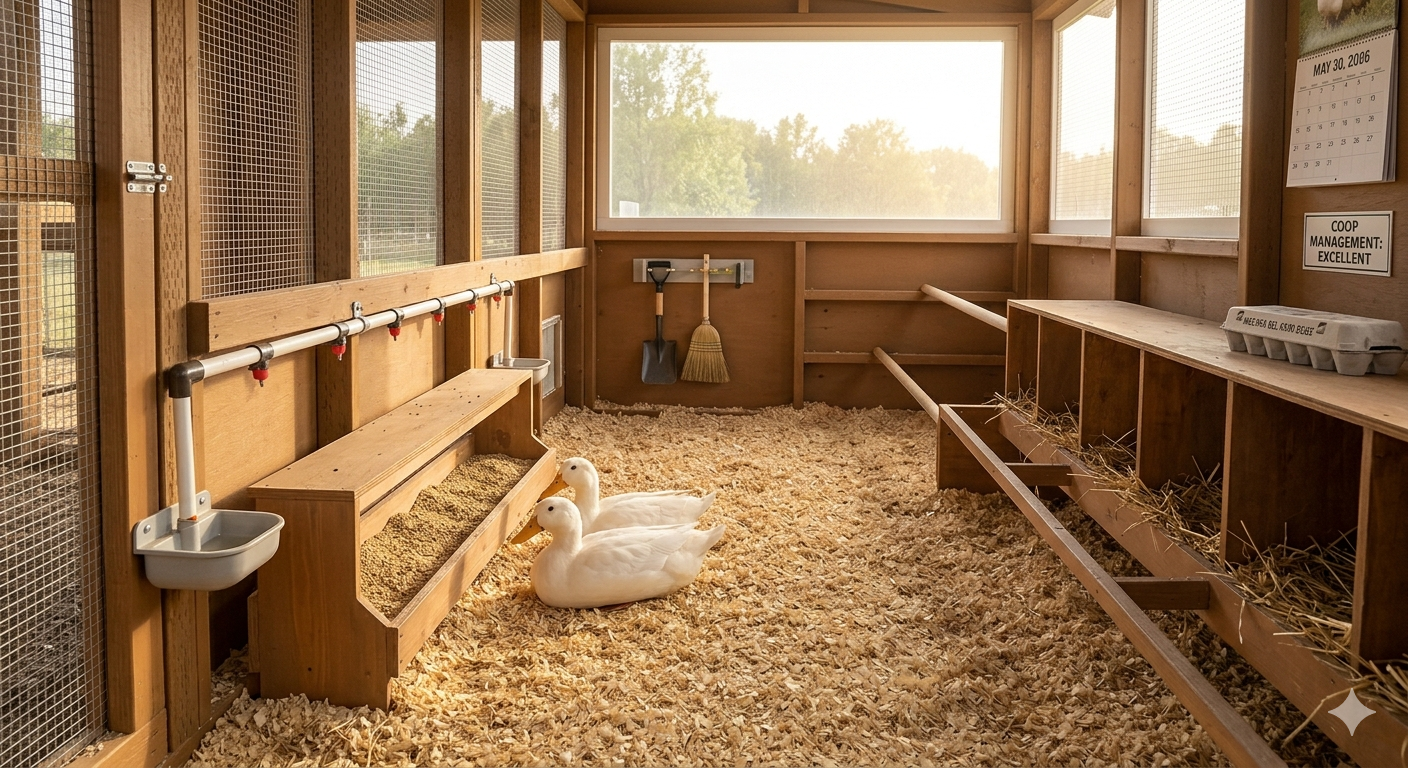
Moisture management over absorption: The most important quality in duck bedding is not how much moisture it absorbs — it is what it does with that moisture afterward. Bedding that absorbs moisture and holds it stays wet, stays warm, and becomes a bacterial breeding environment. Bedding that absorbs and then allows moisture to evaporate upward keeps the surface drier despite the same moisture input.
Deep litter compatibility: Most duck keepers using effective bedding management maintain a deep litter system — adding fresh layers on top of older material and allowing the composting process to manage the moisture. The bedding material needs to be compatible with this approach, meaning it should not compact into impermeable layers that prevent moisture movement.
Safety for ingestion: Ducks may sample bedding. Choose clean, non-toxic material with particles too large to create excessive dust, and seek veterinary advice if a bird consumes a large amount or shows reduced appetite, abnormal droppings, or crop problems.
Option 1: Pine Shavings — The Best Overall Choice
Pine shavings — large-flake wood shavings from pine lumber — are the most widely recommended duck bedding material among experienced keepers and the choice that most consistently delivers the combination of moisture management, ease of cleaning, affordability, and availability that duck bedding requires.
Pine shavings are my favorite for quick cleanup. They soak up moisture well and help keep duck smells down. I lay down a thick layer, about 2 to 3 inches deep. I check the bedding every day and add new shavings if needed.
Why they work: Large-flake pine shavings absorb moisture quickly from the surface but remain relatively loose rather than compacting into a saturated mat. This loose structure allows moisture to move downward and allows air to circulate between the particles, promoting the evaporation that keeps the surface drier than the total moisture input would suggest.
Spot cleaning: The most important daily task with pine shavings is spot cleaning the area directly beneath where the ducks sleep — this is where the majority of overnight waste accumulates. Remove saturated clumps daily and add a fresh layer on top. This approach, combined with weekly full ranking and monthly deeper management, maintains a genuinely clean coop with manageable effort.
Depth: Maintain a minimum of 4 inches. Six inches provides better moisture management and better insulation in winter. Do not allow the total depth to fall below 4 inches before adding fresh material.
Important: Use large-flake pine shavings only. Avoid very dusty sawdust in enclosed housing because airborne particles can irritate eyes and airways. Strongly aromatic cedar shavings are also best avoided in enclosed poultry housing; choose low-dust, kiln-dried bedding and maintain ventilation.
Cost: Moderate. Buying in bulk — full bags from a farm supply store or agricultural supplier — reduces cost significantly versus purchasing in small quantities.
Option 2: Straw — Beautiful but Challenging
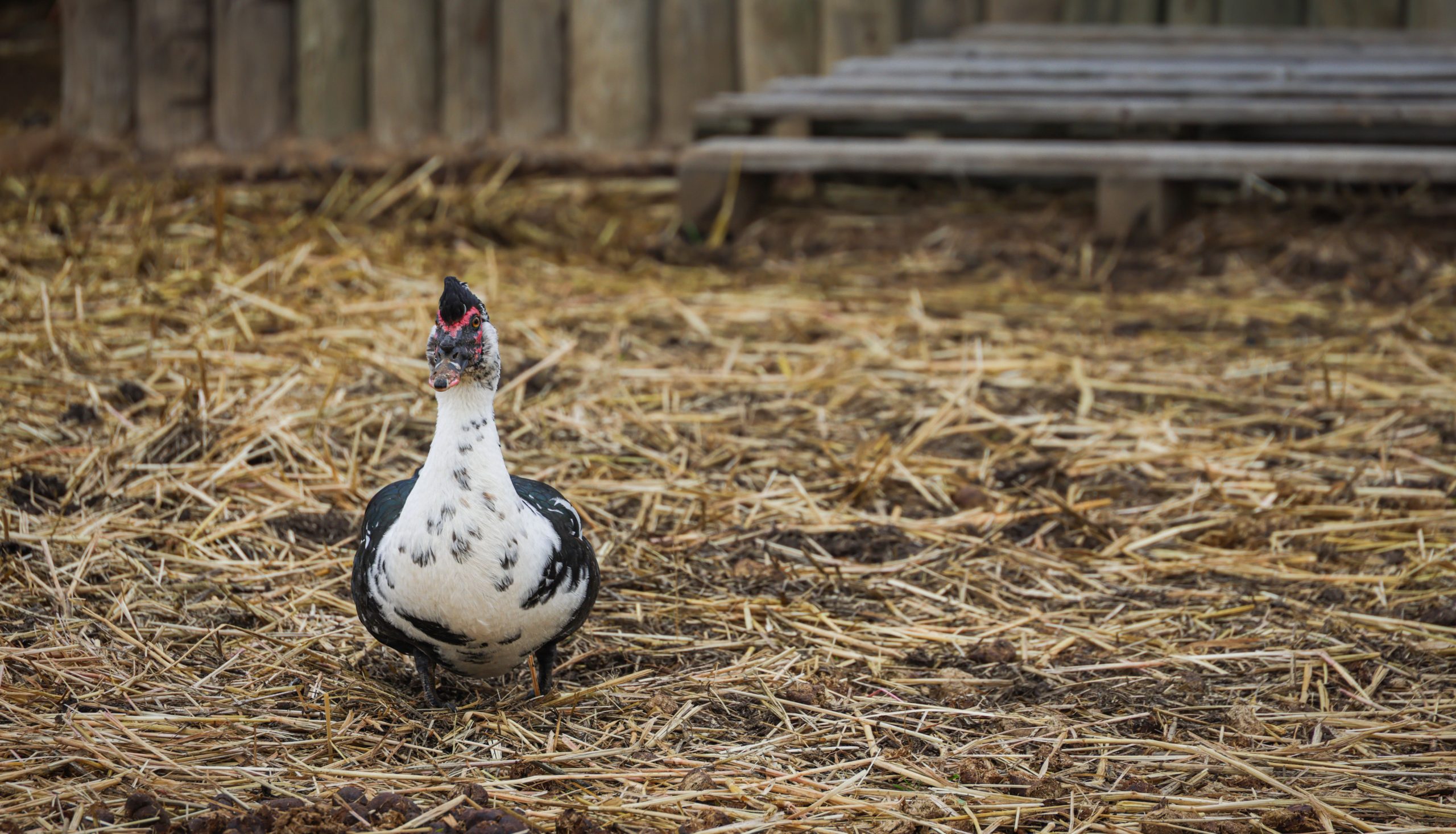
Straw is the bedding that duck coops look best with in photographs. The warm golden color, the rustic aesthetic, the pastoral quality it lends to any farm setting — these are real visual qualities that explain why straw appears so frequently in duck coop content on Pinterest.
The management reality is significantly more challenging.
Why it struggles: Straw absorbs moisture and then mats — it forms a dense, compacted layer that traps moisture rather than releasing it upward. In the duck coop, where moisture input is constant and substantial, straw bedding becomes saturated and stays saturated. The warm, wet, organic environment that saturated straw creates is precisely the environment where bacteria and mold thrive.
Where it works: Straw performs better in the deep litter system than as a regularly changed bedding layer — adding new straw on top of existing material and managing it as a composting system allows the decomposition heat to manage moisture better than straw alone can. In dry climates with good coop ventilation, straw is more manageable than in humid climates with poor airflow.
Where it absolutely fails: In nesting boxes, straw becomes soiled and matted very quickly and should be replaced completely and frequently rather than added to. For keepers who want the aesthetic of straw without the management challenges, straw in the nesting area refreshed twice weekly, and pine shavings as the main coop floor is a workable compromise.
Option 3: Sand — Excellent Drainage, Specific Requirements
Sand — specifically coarse construction sand, not fine play sand — provides excellent drainage in duck coops. Droppings sit on the surface rather than being absorbed; they dry relatively quickly, and the surface can be cleaned by raking and scooping, similarly to a cat litter box.
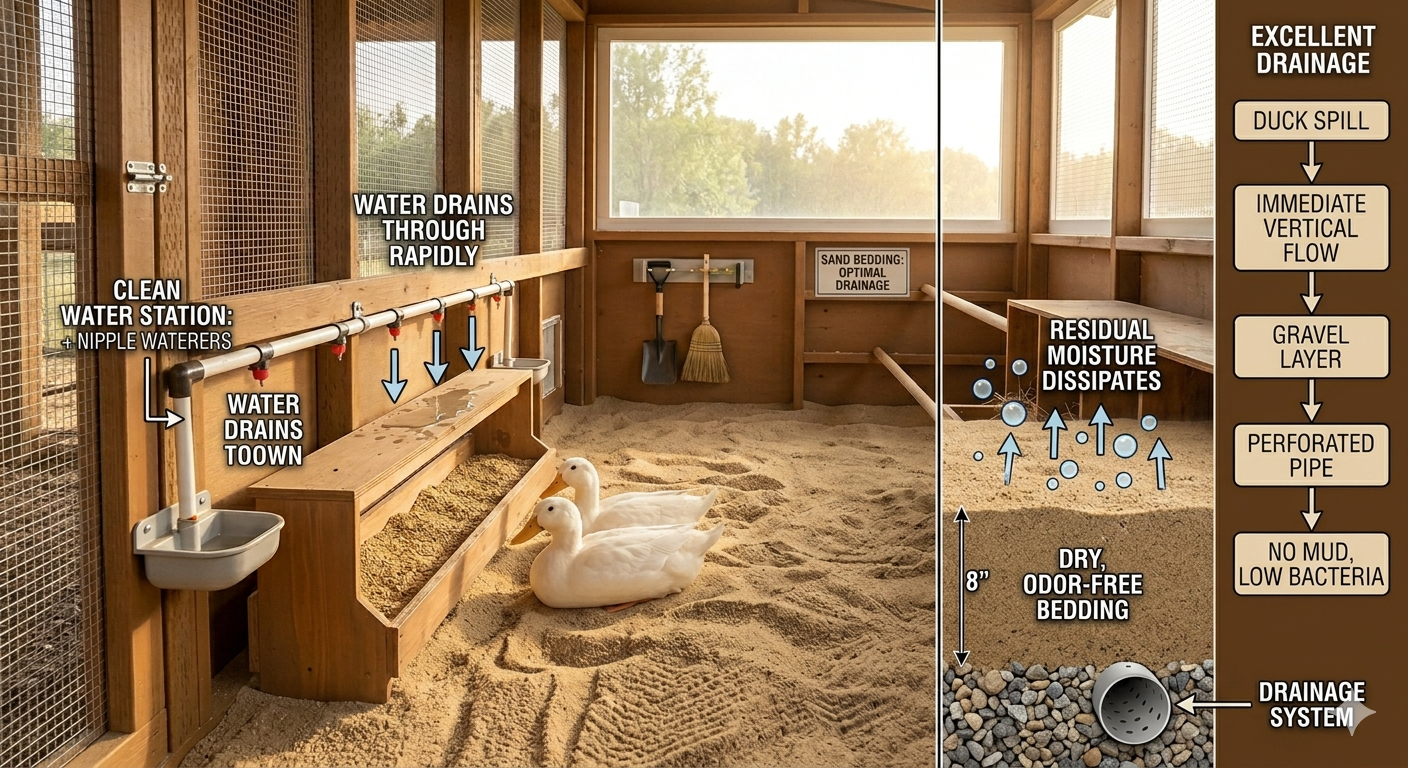
Why coarse sand specifically: Fine sand can compact when wet and become dusty when dry. If using sand, choose clean, washed, appropriately graded material without silica dust, sharp debris, or construction contaminants, and monitor for consumption or foot irritation.
The drainage requirement: Sand works best in coops with excellent drainage infrastructure — sloped floors with drain channels, or coops built above a gravel base that allows water to move through and away. In coops without this drainage, sand can become waterlogged in wet climates and create a cold, uncomfortable floor surface that is harder to manage than pine shavings.
The weight consideration: Sand is heavy. Installation and replacement require significantly more physical effort than any other bedding option. For keepers with physical limitations, this is a genuine practical barrier.
Where sand excels: In the run area around water sources — the pool, the waterer — pea gravel (the finest category of coarse drainage material) or coarse sand provides a surface that drains immediately, resists mud formation, and can be hosed clean daily without becoming a management burden.
Option 4: Hemp Bedding — The Premium Option
Hemp bedding — made from the inner core of the hemp plant — is emerging as a genuinely impressive duck bedding option for keepers who are willing to invest more for significantly better performance.
Hemp absorbs moisture rapidly — faster than pine shavings — and releases it upward through evaporation more effectively, keeping the surface drier with the same moisture input. It composts rapidly when removed, and it is produced without the pesticide applications that some grain straw may carry. It also has naturally antimicrobial properties that reduce bacterial growth in the litter.
The limitation: Cost. Hemp bedding costs significantly more per bag than pine shavings and is not available at every agricultural supplier. For a small flock in a small coop, the cost premium may be justifiable. For a large flock in a large coop, the running cost of hemp bedding versus pine shavings is a meaningful budget consideration.
Option 5: The Deep Litter Method With Any Appropriate Bedding
The deep litter method is not a bedding material — it is a management approach that can be applied to pine shavings, straw, or hemp bedding. It deserves its own entry because it changes the performance of any bedding material significantly.
The deep litter method starts with a layer of bedding about 3 to 4 inches thick across the floor. When the bedding gets dirty, add another fresh layer on top rather than removing the soiled material. This saves full cleanouts every week. Turn the litter every week so it stays dry and reduces bad smells.
Important limits: Deep litter is harder to manage with ducks because their moisture load can overwhelm the material before a stable composting layer develops. It should never feel wet, smell sharp or rotten, or form dense mats. Add dry carbon material only while the surface remains friable, and perform a full cleanout whenever moisture or odor persists.
Ventilation: Deep litter requires ample airflow and close monitoring. It is not a dependable heat source and should not be used to compensate for inadequate shelter. Beginners in humid climates may find frequent spot-cleaning and regular replacement easier and safer.
Two Bedding Materials Best Avoided
Cedar shavings: Strongly aromatic cedar products can release volatile compounds and may irritate birds in enclosed spaces. Because safer low-dust options are widely available, use pine, aspen, hemp, or another suitable material instead.
Hay: Hay is feed material rather than bedding and can retain moisture or mold when packed into a wet coop. Straw is different, but it also needs frequent monitoring and replacement when damp or matted. Discard any material that smells musty or shows visible mold.
The Daily and Weekly Routine That Makes Any Bedding Work
The best bedding in the world managed poorly produces worse results than adequate bedding managed well. The routine matters as much as the material.
Daily (5 minutes): Spot clean the area directly beneath where the ducks sleep. This is where overnight waste is most concentrated. Remove saturated clumps and add a thin fresh layer. Check water access — moisture from waterers spilling into bedding is manageable through position adjustment.
Weekly (15–20 minutes): Rake the entire floor to aerate and break up any compacting areas. Add fresh bedding material across the full floor to maintain depth. Assess overall moisture content — if the entire floor feels damp, the ventilation is insufficient, and needs addressing before bedding management alone can solve the problem.
Monthly or seasonally: Full cleanout. Remove all bedding, clean and dry the floor, and restart with fresh material. In well-managed coops, monthly full cleanout may be more frequent than necessary — some keepers with excellent daily management maintain their deep litter for a full season before a complete replacement.
Choosing the Best Bedding for Your Setup
The right bedding helps manage moisture and odor, but it works only alongside drainage, ventilation, suitable stocking density, and consistent cleaning.
Pine shavings, managed daily with spot cleaning and weekly with fresh additions, will serve the majority of duck keepers excellently. Hemp may offer good absorbency at a higher cost. Sand can work in a well-drained design, while deep litter demands particularly close moisture and odor monitoring with ducks.
Check the label and condition of every bedding bag, store it somewhere dry, and judge performance by the actual surface: it should remain clean, friable, low-dust, and free of sharp or musty odor.
Sources and further reading
- Cornell Duck Research Laboratory: Duck housing and management
- Merck Veterinary Manual: Aspergillosis in poultry
Continue Exploring Your Backyard Flock
Use these closely related guides to plan your next steps:


2 thoughts on “Duck Coop Bedding Done Right: 6 Options Ranked Honestly From Best to Worst”
Comments are closed.